Dr. Wilkins
The Mysterious Affair at StylesDr. Wilkins is the local doctor responsible for Emily Inglethorp’s medical care. He arrives after Dr. Bauerstein has attempted to revive her, explains her collapse as a consequence of her weak heart and overwork, and later confirms at the inquest that she died from strychnine poisoning. His evidence supplies important medical facts, but its limits are equally consequential: the case’s solution depends on distinguishing what his tests ruled out from what they never tested, and on recognizing that the prescribed medicine itself carried the fatal dose.
Identity and Medical Role
Dr. Wilkins is described as Emily’s own doctor and as a portly, fussy local practitioner. He reaches her room after Dr. Bauerstein, who had happened to be passing the lodge gates when the car was sent to fetch medical help. Bauerstein explains the circumstances of his arrival and indicates Emily’s condition; Wilkins’s first response is to attribute the death to her habit of doing too much despite his advice and to her weak heart. He says her commitment to good works had exceeded what her health could bear.
That explanation is offered before the medical findings have established the cause of death. Dr. Bauerstein watches Wilkins closely as he speaks, then emphasizes that the convulsions were unusually violent and tetanic. The exchange places Wilkins’s familiar account of Emily’s health beside a symptom that calls for a more exact explanation. His initial interpretation does not settle the cause; it becomes a contrast against which the later toxicological evidence can be assessed.
Evidence at the Inquest
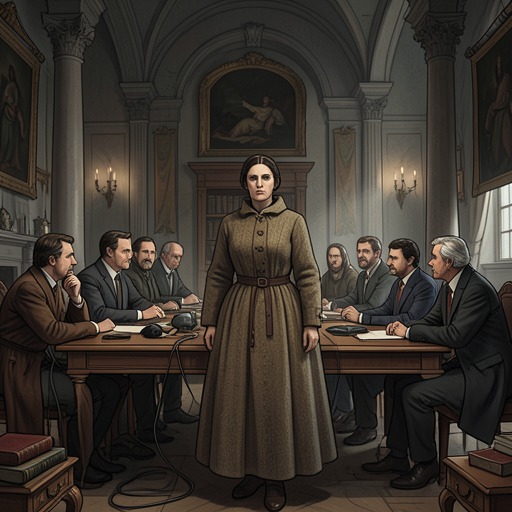
At the inquest, Dr. Wilkins corroborates Dr. Bauerstein’s medical testimony. The post-mortem establishes that Emily died of strychnine poisoning, with an estimated amount of at least three-quarters of a grain and probably about one grain or slightly more. The amount makes accidental ingestion seem unlikely: the specialist explains that strychnine is not ordinarily used for domestic purposes and that its sale is restricted.
The timing of the symptoms complicates the apparent case against the after-dinner coffee. Strychnine generally produces symptoms within one to two hours, while Emily’s coffee was believed to have been taken at about eight in the evening and her symptoms appeared in the early hours. The medical witness therefore reasons that the poison was probably taken later, unless its action had been delayed. The household’s usual explanation that Emily sometimes drank cocoa during the night is also tested: a sample remaining in the saucepan is reported free of strychnine. The broken coffee cup, however, cannot be analyzed, leaving no direct test of its contents.
Wilkins’s evidence supports the conclusion that Emily was poisoned, while narrowing the possibilities without resolving the delivery mechanism. His corroboration does not make the coffee theory conclusive: the interval between the suspected meal and the symptoms remains problematic, and the cocoa test excludes strychnine in that sample. Poirot’s investigation later makes clear that the fatal poison was taken in Emily’s medicine, not in either drink.
Rejection of Alternative Explanations
Lawrence Cavendish proposes at the inquest that repeated doses might have accumulated until they caused death, or that Emily might accidentally have taken too much of her medicine. Wilkins is recalled and rejects the suggestions. He concedes in principle that strychnine can be cumulative, but says that a sudden death of this kind would require a long period of chronic symptoms, which would have drawn his attention. He calls the proposed accumulation impossible in this case.
His response also shows how medical reasoning can rule against an explanation without yet revealing the actual mechanism. The theory of gradual accumulation does not match the sudden onset described at the inquest, and an accidental overdose is not accepted there as an adequate account. Yet the fatal dose does come through Emily’s medicine: the distinction is that the medicine had been altered so its strychnine settled and became concentrated at the bottom, where it could be consumed in a final dose. Wilkins dismisses the wrong mechanism, not the possibility that his prescription is implicated.
Prescription and the Final Explanation
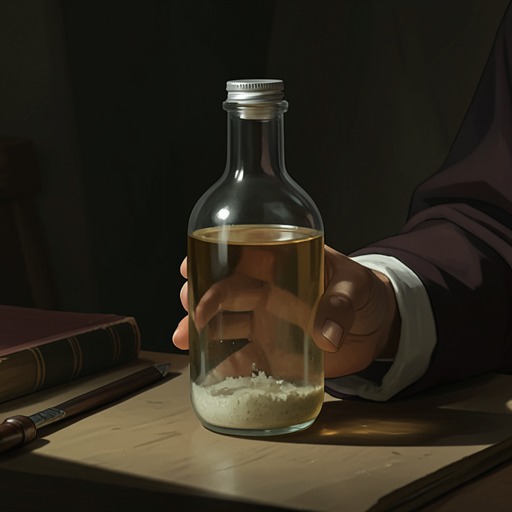
Poirot’s reconstruction identifies the strychnine in Emily’s medicine as the same strychnine Wilkins had prescribed. A dispensing reference describes a mixture in which strychnine can precipitate as insoluble bromide crystals; if the sediment gathers at the bottom, the person taking the last dose may swallow nearly all of it. Poirot explains that the prescribed mixture did not itself contain bromide, but that bromide powders added to a full bottle would cause the precipitation described in the reference. The person who ordinarily poured Emily’s medicine was careful not to shake the bottle, leaving the sediment undisturbed.
This mechanism explains why the poison did not produce the pattern Wilkins’s cumulative-poisoning objection anticipated. The decisive danger was not a long series of progressively harmful doses but the concentration of the existing strychnine in the bottle’s final portion. The prescription supplied the poison; the added bromide and the undisturbed sediment determined how it was delivered. Wilkins’s treatment of Emily is therefore central to the physical chain of evidence, even though the evidence does not establish that he knew the medicine had been altered.
Limits of the Evidence and Narrative Significance
The investigation repeatedly separates a test’s result from the question it was asked to answer. Dr. Bauerstein’s analyst examined the cocoa sample for strychnine and found none. Poirot later points out that the sample had not been tested for a narcotic, and his additional analysis identifies a safe but effective narcotic in the cocoa. That discovery accounts for the sedative effect on Emily and Cynthia, while also helping explain why the remaining cocoa could not by itself expose the poisoning mechanism. The distinction does not invalidate the earlier strychnine result; it shows that a negative finding about one substance is not a complete analysis of the sample.
Wilkins thus occupies an important position between ordinary medical care and detective reconstruction. He recognizes Emily’s frail heart, corroborates the evidence of poisoning, and rejects an explanation that conflicts with the sudden course of her death. But the decisive account emerges only when the prescription, the precipitating bromide, the bottle’s untouched sediment, and the timing of the fatal last dose are considered together. His role gives the mystery a precise medical framework while underscoring its central evidentiary lesson: an accurate finding can remain incomplete when the material has not been tested for the right question.